Showing posts with label natural dye. Show all posts

Wednesday, October 14, 2009

Square 69: Thanksgiving


Square 069


Things I am thankful for.

The gift of two unique and beautiful daughters. Being in love with a man with whom love-making has never—not for an instant—been boring. My dad being alive and well and happy.

My laptop, my camera, my apartment, the new houseplants I’ve kept alive for the few weeks since I moved in.

My cottage, especially my cottage when the sky is clear and the lake is warm, the water blue from above and golden underneath.

The two aunts who encouraged me to bring Danny to my mother’s memorial, the cousin who has cheered me on, my friends.

The places where I like to hang out and write like the Red Brick CafĂ© and the Green Room. Community hubs like Out On The Shelf, the Rainbow Chorus, Writers’ Circle and Rainbow Knitters.

The insight that allows me to derive my own meaning in a universe that is inherently meaningless. Depression that taught me to treasure each day. Creativity that allows me to create treasure. Eyes to see beauty, ears to hear music.

Especially Sibelius’ Symphony Number Two. Also Schubert, Brahms, Dvorak, Rachmanninoff, and Vaughan Williams.

The intimacy that comes as two strangers learn to trust, the joy that comes from trusting myself enough to be alone and enjoy my own company.

Computer games that distract me. Good food that gives pleasure.

Being in love with a patient listener.

Losing my temper. I mean really losing it, for so long that I could almost forget the feeling of uncontrolled anger. The challenge of calm and simplicity that somehow elude me but draw me ever higher and onward.

The words of Stephanie Dowrick, Natalie Goldberg, Annie Dillard and Ursula K. LeGuin; the worlds of C.S. Lewis and J.R.R. Tolkien; the imaginary characters who have kept me company; the real friends who replace them.

My 1920s oak library table.

A grandfather who liked to tell stories and nibble my toes.

All the stars in the universe, meteor showers, the planets, all the things we have yet to discover, all the mysteries that keep us humble, a universe that is far too complicated for us to understand.

Oh yeah, and nature, how could I forget my favourite herbs, shrubs and wildflowers? Let’s start with lilacs, lavender and lemon verbena, the fringed gentians the bloom in August at Singing Sands, magnolias and old-style, fragrant yellow roses, lady’s slipper orchids, sundews and pitcher-plants, the fragrance of a pool of violets in spring, the radiance of a meadow of asters and goldenrod in autumn.

There’s also the birds, especially cedar waxwings, eccentric and gregarious, but also catbirds, all the warblers I learn to identify by ear.

I mustn’t forget pianos, radios or CD players. Cars.

Grocery stores full of familiarity and discovery. Peaches and apricots, mushrooms, shellfish, all kinds of cheese, red wine, liqueurs, pesto, dark chocolate.

My kitchen, my bed, the shower, the windows where sun shines in.

Hardwood floors and stained glass windows, pipe organs, bookstores.

The Eramosa River, Lake Fletcher, Lake Erie, Georgian Bay, Hockley Valley. Towns that enchant and cities that engage.

Live theatre, symphony orchestras. Rufus Wainwright and k.d. lang. Her voice, yes thank you for her voice.

That early memory of running barefoot through the grass with the drone of cicadas in the air.

The memory of my last evening with Mom when we had the conversation I never expected to have, so full of forgiveness. The full lunar eclipse on the night she died and all the full moons since.

The fellowship of lost friends as long as it lasted.

A quiet place on rocks by a stream, deep in the woods, just sitting and watching.

Walking on a winter night on the ice under a full moon, or walking under no moon when the Milky Way is so brilliant I can feel the distance and depth of the stars. The forlorn call of a loon at night, the blinking of fireflies, the choir of toads by a river in Guelph on a mild May evening, the way nature fills more of my life when I let it.

The special way I have of seeing colour and putting different colours together. The way photography, writing and fibre seem to play off of one another.

Sunday, October 11, 2009

Square 68: Fall


Square 068


It's the Sunday morning of Thanksgiving weekend at Lake Fletcher. Hard frost during the night. Mist rises from the lake, and long beams of the rising sun highlight brilliant maples on the far shore. The dock is slick. Each leaf fallen there is beaded with pearls of ice, or laced around the fringes.

The air is perfectly still. Leaves sift constantly downward, tickling their sisters, whispering, “Come with me!” Two chipmunks chase one another through the undergrowth of bunchberries. A pair of nuthatches visiting the feeder utter soft, staccato syllables to keep in touch. There is no other sound.

Thursday, October 8, 2009

Square 66: Elderberry


Square 066


Across the road from our house, my parents owned a vacant field that verged on a marsh. There I planted several native shrubs, like snowberry, in hope of attracting wildlife. Then I discovered something growing wild there, one of the things that birds like best: an elderberry bush. I tried making jam from the berries, but it failed. It was full of the seeds, and the sugar crystallized. I didn't make successful elderberry jelly until many years later. But this plant remains for me an icon: nature feeding us, feeding itself, sustenance, sweetness, the cycle of life. Coincidentally, the dark purple Cascade yarn I chose to use as a common thread throughout this blog blanket is precisely the colour of ripe elderberries.

So it was with particular guilt that I cut down an elderberry bush at Danny's house yesterday. In this small Toronto backyard it was not just growing, but burgeoning, taking over its corner, threatening to shoulder the house aside. Elderberries favour moist, rich soil, and I think this part of the city used to be part of Lake Ontario, so the roots must have lots of rank, dark, dirty depths to thrive upon.

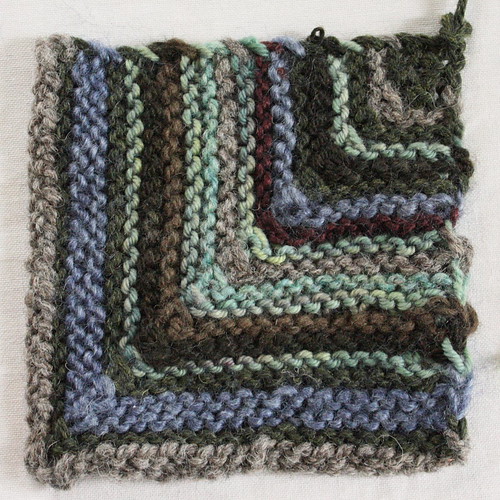
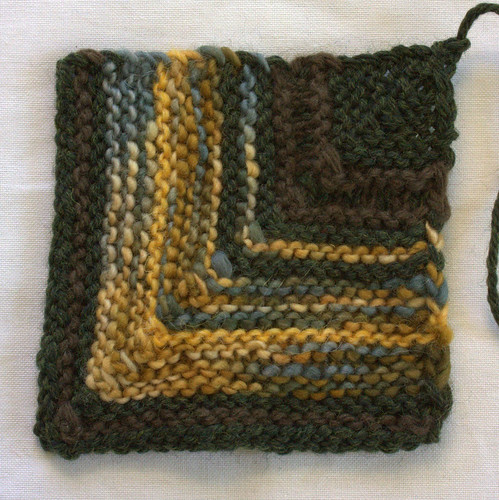
The birds came to feed on the berries every summer. I've made jelly from them, and Danny has dyed yarn. The greenish-grey fibre in this square came from that dye pot. So we owe that shrub a lot of thanks.

Instead, we cut it down. Sometimes plants get in the way. It's a fact of life in the city, where space is limited.

When I approached the shrub with gloves and saw, I startled a robin and some white-throated sparrows (Bill has also seen a tribe of Baltimore orioles there). They hesitated to fly away, hovering around as I began hacking at the branches. They couldn't believe it. But by the time the brush all lay in a pile, they had given up and gone away. Later in the afternoon, a forlorn wood thrush appeared on the fence and looked around, casting a mournful, beady glance in my direction, flicking its rusty brown tail in indignation. It circled the yard once or twice before fluttering away in silence and despair.

Guilty. I am guilty.

But as a phoenix rises from the ashes, so a hacked elderberry will re-emerge from the muck, if not here then somewhere else. This particular plant has been cut to the ground several times already. Our world will not soon be rid of them. Ontario will have plenty of fruit for jelly and dye, and for the wild ones to eat.

Wednesday, September 16, 2009

Square 59: Asters and goldenrod


Square 059


There are few sights as resplendent as a September meadow full of asters and goldenrod. I dream of making a tapestry to portray this beauty.

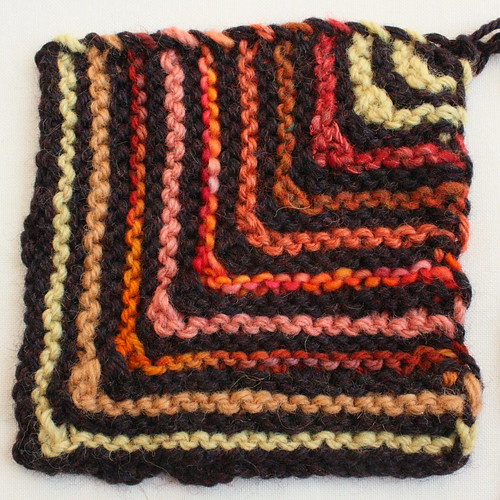
A few years ago Danny and I dyed some yarn using goldenrod flowers. Natural dyes often smell foul, but that dye pot made the whole cottage smell like warm honey, and the fragrance clung to the yarn for a long time. I used that yarn for the three rows of light gold in this square.

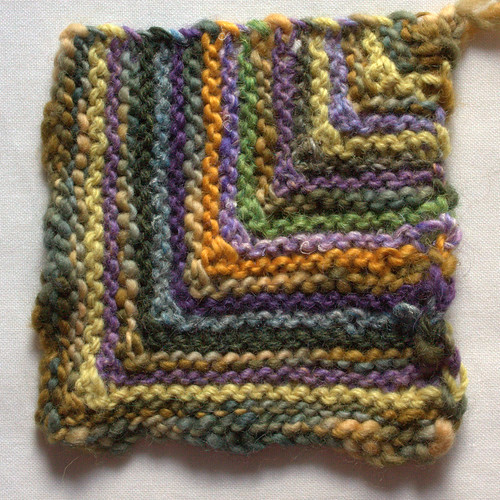
Wild asters come in many colours. I took all the yarn for this square on an outing where I planned to knit it, but up arrival discovered I had forgotten to pack any white, one of the most common colours and an essential part of the meadow fabric. But several of the Noro yarns I had brought showed white threads of silk, so I used these, doing my best to set their highlights off against saturated solid rows.

Pale pinks are also common. One of my favourite species is Aster lateriflorus or calico aster, so named because the central discs of the flowers vary from yellow to pink, purple or brown on the same plant.

But perhaps the largest and most distinctive is the vivid purple New England aster, Symphyotrichum novae-angliae. This colour is not as easy to derive from natural sources, but I'll have to find it for my tapestry.

I haven't gone on a walk to see asters and goldenrod yet this year. When I thought of doing this square, it reminded me that last year I walked every day from April to December to create a daily photo journal of nature. This year my nature walks have been far fewer, and this story blanket is partly to blame. I haven't had time.

There is not time in life to do everything we want. I have a hard time accepting this truth. When I think about time I tend to feel impoverished. Instead I ought to focus on the richness of opportunities and savour each day as a gift.

Last year I went on a lot of walks, saw some things I had never seen before, took thousands of photographs and created a remarkable photo journal. It was good. I try to take pleasure in the memory, understand that it is still part of my life, even though it's in the past.

It's no good to regret what I haven't done in 2009. Instead of walking and taking photographs every day, I have worked long and hard on this story blanket. It commemorates many things I have seen and love, like asters and goldenrod. It is good, too.

When I am finished I will move onto another adventure, and it will be good, and maybe someday I will lose this habitual regret.

Tuesday, July 28, 2009

Square 42: Verdant


Square 042


When Daniel mentioned that the green yarn from Tanis Fiber Arts reminded him of ferns, the first thing I though of was a place near my cottage. It is not far, perhaps 100 metres, but we rarely go there. You have to cross the road, pick your way through overgrown brambles, penetrate a wall of maple samplings, navigate of maze of ephemeral streams through the leaf litter and climb steeply uphill, all while fending off a host of mosquitoes from the nearby swamp.

Beyond all these barriers lies a deep forest sanctuary against a north-facing granite wall perhaps 12 metres high. Many tall hemlocks stand there. Others have fallen over the years. The ground is jumbled with jagged boulders and trunks. In the deep shade, ferns and lichens encrust the exposed rocks. I did not discover that particular grove until well into my teens, and I suppose the reason it enchants me is it reminds me of the Pacific Rim forest I wrote about in Square 12.

I never find evidence that any other humans have visited that part of the forest, but I have occasionally taken friends and my daughters there. Everyone wants to climb the cliff. The first time I climbed it was with my friend Mary and her younger brother, Rob. They were small and lithe and moved rapidly upward from handhold to foothold. I followed, but got stuck somewhere halfway up, unable to move forward or back. Mary had to describe the unseen purchases above my head so I could feel my way, finally reaching the top.

At the crest is a different world, equally magical. The same hemlocks dominate the canopy, but it is bright and open, breeze swaying the branches. At certain points you can see through the leaves to distant low stretches of lake like sapphire under the sun. The ground is soft, covered with reindeer moss and true mosses. It is tempting to sit and let the forest massage your senses.

I haven't visited the place in a while, but during this week of life change—rushing, packing, trying to remember everything that must be done—I often find my mind wandering there, scrambling through the verdant shadows to find a quiet place far from the madness.

As the blanket progresses, I am particularly intrigued with squares that use many different yarns to create a watercolour effect. This square utilizes eight yarns: an unknown grey remnant, Cascade 220 Olive Heather, blue Patons Soy Wool Stripes, Moss from Tanis Fibre Arts, a similar lichen green colour from Briggs and Little, some dark green-brown yarn handspun by Danny, some brown yarn I hand-dyed with black walnut, and dark auburn Tupa from Mirasol Peru.

Monday, May 25, 2009

Square 8: Life begins in the soil


Square 008


Friday afternoon Sylvie and I planted vegetables in the narrow soil border along the parking lot behind the building where I live. This will be the garden's second season. I'm trying to dig myself deeper into the soil.

American farmer, poet and economic critic Wendell Berry has said, "Urban people are connected to the land by their gastrointestinal tract." It's a tenuous relationship.

I grew up in the country and began learning principles of organic gardening from Ranger Rick magazine, but my family were city people so I had to learn more from experience than example. Early attempts at a vegetable garden were overrun by quackgrass and I did not develop faith in the Earth until much later.

During the 1990s I lived for three years on top of a hill of glacial gravel and attempted to establish a garden there. Preceding tenants had drenched the lawn with chemicals. The soil was dry and lifeless. I began by applying a few principles of permaculture I had read, laying down layers of newsprint, covering it with grass clippings, dried leaves, manure and any other organic material I could lay my hands on, and planting vegetable seedlings through these layers into the stony soil below.

The first two years were disappointing. Blight stunted the tomato and potato plants, while groundhogs ate practically everything else. I learned the creatures were attracted to cabbage crops, so by eliminating broccoli, Brussels sprouts and kohlrabi from the plan I persuaded rodents to leave everything else alone.

But more importantly, two years of adding voluminous organic material to the soil finally paid off. During the third summer the garden produced bumper crops of tomatoes, beans, onions and sweet corn.

It was a revelatory experience. I learned that you don't feed vegetables, you feed the soil. It is a complete ecosystem containing more species diversity than a tropical rainforest. Microscopic bacteria, fungi and protozoans, tiny nematodes, springtails and mites, larger earthworms, beetles and colonial insects, and the small mammals and birds that feed on them are members of an interdependent community. They support the cycles of water, gases and nutrients and maintain the soil structure that fosters healthy plants. Recent research has revolutionized understanding of how plants grow. For years farmers knew that the roots of certain crops harboured beneficial bacteria that fixed atmospheric nitrogen and made it available to plants, but we now realize plant roots depend on healthy symbiosis with a wider range of organisms. For example many tree species depend on symbiotic relationships between their roots and certain fungi.

If you have a garden, take time this season to think about what you're feeding it. If not, consider it whenever you pause to admire a rose, or pick up fresh produce from the supermarket. Many of us were raised to abhor dirt, but healthy soil is more valuable to life than pure gold.

While planting tomatoes, beans, peppers, chard and herbs, I got the idea to knit a square that would illustrate the dark beauty of the soil and its relationship to plants we depend on for food. It is not all bucolic and lovely either. Healthy dirt reminds us that nature depends on a healthy balance between life and death. We can't have one without the other. Beneath our feet carry on countless tales of predator and prey. Soil smells good when it is full of killing, eating, rotting, growing and breeding.

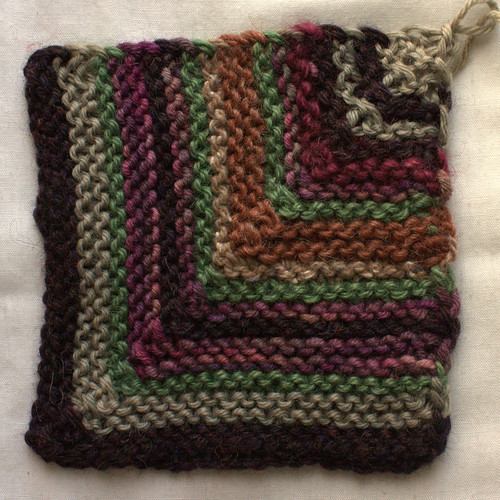
This square is comprised of four yarns: background Cascade in deep green, a brown three-ply wool I hand-dyed with black walnut, a variegated Malabrigo merino worsted in shades of growing plants, and an accent of yellow Létt-Lopi to highlight the relationship to sunlight.